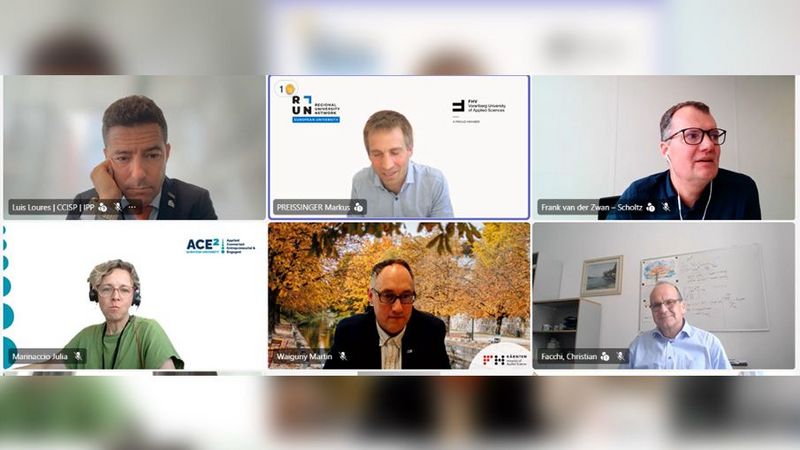
On 15 June, the ACE²-EU Virtual Coffee brought together a distinguished panel of experts to discuss the current landscape and future prospects of applied doctorates in Europe. The discussion featured representatives from five institutions across four European countries and two European University Alliance:
- Martin Waiguny, Carinthia University of Applied Sciences, Austria - ACE²-EU
- Christian Facchi, Technische Hochschule Ingolstadt, Germany - ACE²-EU
- Markus Preißinger, Vorarlberg University of Applied Sciences, Austria - RUN-EU
- Frank van der Zwan-Scholtz, Dutch Association of Universities of Applied Sciences (Vereniging Hogescholen)
- Luís Loures, President of Portalegre Polytechnic University, representative of the Conference of Polytechnic Universities in Portugal, and Board Member of EURASHE
While Austrian Universities of Applied Sciences (UAS) still face legal and structural hurdles in providing doctoral education on an equal footing with traditional universities, Germany, Portugal and the Netherlands have successfully made the case to governments and higher education stakeholders for granting doctoral awarding powers to UAS institutions.
The panelists identified three key factors that drove this change: building trust in the quality of applied doctoral education, ensuring the distinctiveness of programmes and complementarity of programmes, and securing support from regional stakeholders and students.
The topic of applied doctorates at UAS has gained considerable momentum across Europe over the past decade, with the European Union increasingly recognizing the importance of applied higher education and research for Europe's competitiveness and innovation capacity.
The panelists agreed that European University Alliances will not only provide a platform for developing more joint applied doctoral programs, but can act as models that recognize UAS as equal partners, thereby helping overcome remaining structural, legal and political barriers.