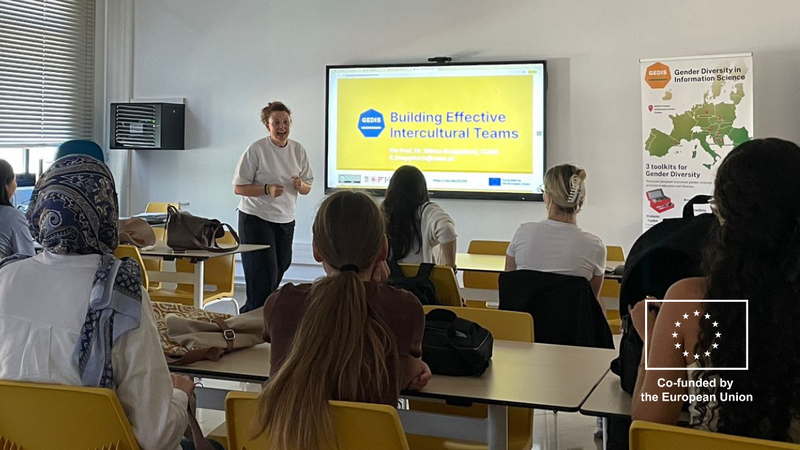
At this year’s GEDIS Summer School, hosted at the Universitat de Barcelona and led by Juan-José Boté Vericad, these disciplines came together in an interesting and generative way. The result was a week not only of academic learning for CUAS students and staff, but of critical reflection, co-creation, and intercultural dialogue. The program brought together students and faculty from diverse academic and cultural backgrounds to explore intersections between technology, ethics, and diversity and to contribute to the production of Open Educational Resources (OERs) that reflect these complexities.
The GEDIS consortium, coordinated by the University of Barcelona, includes partner institutions across Europe, including:
- University of Sarajevo (Bosnia and Herzegovina)
- University of Hildesheim (Germany)
- University of Osijek and University of Zadar (Croatia)
- Silesian University in Opava (Czech Republic)
- Carinthia University of Applied Sciences (Austria, FH Kärnten)
Beyond Disciplinary Silos: What Emerged
The week, partly taught by Stefan Dreisiebner and Eithne Knappitsch from the School of Management, brought together students and faculty from diverse academic and cultural backgrounds. Some highlights included:
- Discussions areound AI and ethics moved well beyond what is technically possible to interrogate what is also responsible. Students questioned not bias in data as well as power in systems.
- Sometimes omitted from technical curricula, these themes were a core part of the week and were treated with the care and complexity they demand.
- The intercultural team-building session was hands-on, sometimes a little uncomfortable, but in a productive way.
What We Noticed
Students co-constructed shared vocabularies, embedded in authentic lived experience and critical of bias and default assumptions. Over the course of the week, the need to adapt—linguistically, disciplinarily, and interpersonally—surfaced invisible norms and created space for mutual learning. Conversations on topics relevant to student realities included hate speech, disinformation, and LGBTQIA+ and were covered with both intellectual rigor and emotional intelligence.
From FH Kärnten: Why This Matters
Stefan Dreisiebner and Eithne Knappitsch, along with GEDIS partners from Spain, Czechia, Croatia, Bosnia, and Germany used the week to engage in meaningful academic exchange.
The summer school went beyond lectures or project deliverables, creating a relational space to work through complexity together. This Summer School embodied the kind of learning the Fachhochschule Kärnten aims to foster: interdisciplinary, reflective, responsible and grounded in real-world contexts.